|
Most of the theological articles and essays I have written may be read here at NCMI. Since beginning seminary in pursuit of my MDiv, I have written many academic papers which have *not* engaged my mind and heart theologically, or been relevant to the mission of NCMI, which is to bring relevance to Old Testament prophetic texts by showing how they elucidate the nature of Christ's kingdom, thereby enhancing our experience of its fulfillment. However, the academic papers I have *selectively* published here have indeed particularly stirred my passion for Christ, and for living the character of his Kingdom in light of the biblical and doctrinal truths supported by these studies. It is my hope that these papers will not be seen as *merely* academic or dryly cerebral, but rather that they would contribute to *both* our knowledge and experience of the Truth and Mercy found only in the person and work of Jesus Christ, and displayed in our communion as his people. I hope you are edified.
Click here to read these selected articles.
0 Comments
As part of a New Testament seminary course I have been reading a book called Practicing Theological Interpretation by Joel Green. While I am enjoying the book and I do recommend it for its thorough discussion of various hermeneutical paradigms, one section on the "Rule of Faith" as dictated by the "Creed" (singularly referencing the collective creeds of the church throughout history) was challenging. Here is my brief response.
My local faith community does not regularly recite a creed. We do occasionally attend a Lutheran church that uses both the Apostles’ Creed and the Nicene Creed alternately as part of their weekly liturgy. Of these two, I find the Nicene Creed to be the most significant because it affirms Christ’s deity, which I believe is an essential tenet of the Christian faith. However, it would not be accurate to say that the reason I believe Christ’s deity is an essential tenet of Christianity is because the creed affirms it; but rather, I see the creed as affirming what is taught in Scripture. The point of tension arises for me in other areas where I do not hold the creeds (or creed, used collectively) to be infallible. And that tension is increased by the acknowledgment that the same men who composed the early creed(s) of the church also determined what writings were included in the canon of Scripture. It would therefore be illogical for me to say on one hand that the creeds are subject to scrutiny, and are allowed to be questioned by a sincere Christian, but the make-up of the canon is not. There is of course precedent for such questioning in the Reformation era, as Martin Luther challenged the legitimacy of several New Testament books including James. In this week’s reading, Joel B. Green poses the question, “What happens when an otherwise apparently faithful reading of Scripture stands in tension with a claim of the ecumenical creeds of the church” (Green, 81)? I confess I was most disappointed with his answer. He essentially concludes that any theological reading of Scripture that lies outside of the parameters set by the Rule of Faith cannot be considered a “Christian” reading (Green, 98). While he takes great pains throughout the chapter to claim this is not what he is saying, his conclusion reveals a view of the creed that is at least on par with Scripture, if not superior to Scripture. While on one hand I appreciate the “hermeneutical role” he assigns to the creed when he states, “procedurally, a theological hermeneutic might ask, ‘what do we see when we read Scripture through the prism of the creeds that we might not otherwise see?’”(Green, 98); I think he goes too far when he calls the creed the “rule for reading Scripture” (Green, 96). And if he is not placing the creed above Scripture, but merely in “dialectical relationship” with Scripture (Green, 97), then again, why does he conclude so forcefully that any reading of Scripture that is in conflict with the Rule of Faith is not a “Christian” reading? It seems he views the creed as divinely guarded from reformation, even reformation by guidance from the Holy Spirit. Are there errors in the collective ecumenical creed of the church? I believe there are. Are there books in the canon that should not be there? Possibly, but I place my faith in the sovereignty of God over the preservation of the written witness to his revelation, so that regardless of this possibility, the Gospel is preserved with clarity and integrity through this witness. Are there books that were not included in the canon, but should have been? We may discover them yet. Again, it would be illogical for me to allow for the questioning, and the re-examining of the creed in light of Scripture, and hold dogmatically to a fixed canon. To sum up—although in no way to claim resolution to the tension I live with—I esteem the analogy of Scripture (the central message of the whole of it, seen in the unity of its the parts) over and above the Rule of Faith as defined by the creed. Or to put it another way, Scripture’s agreement with Scripture provides a more reliable hermeneutical guide for me than Scripture’s agreement with the Rule of Faith. That is, when the situation arises that a faithful reading of Scripture “stands in tension with a claim of the ecumenical creeds of the church,” I do not dismiss it as untenable merely because of this tension. While I may be forced to admit I am outside the parameters of Christian “orthodoxy,” so were many 16th century reformers who denied the salvific efficacy of water baptism, or the Eucharist as a means of grace, as are all protestants who deny these today. To be continued (as I don't see a resolution to this tension any time soon).... Citations above are from: Green, Joel B. Practicing Theological Interpretation. Grand Rapids: Baker Academic, 2011. The next time someone asks you if you think this or that person could be "the antichrist":
You might explain to them that it is a common misconception that the term "antichrist" in the Scriptures refers to a single individual. There is actually no such individual named or foretold in Scripture, but rather there were "many antichrists" who had come already in the first century. In fact, the apostle John cited this fact as the reason he knew with absolute certainty that it was the last hour. The reason he knew this is that Jesus had told him what signs to look for. In addition to the many "antichrists" that had come already back then, the Bible also speaks of a "spirit of antichrist," which is a lying spirit that denies Jesus is the Christ (cf. 1 John 2:22). These "spirits of antichrist" will always be in the world. But the "many antichrists" of whom Jesus and the apostles spoke are limited to a specific time period, during which Jesus predicted that all which had been written of him in the Scriptures would be fulfilled. While eschatology is not the focus of this exegetical essay on 1 John 4:7-21, the eschatolgical *context* of the passage (including John's reference to the "many antichrists" which had already come) is strongly emphasized: Because He First Loved Us An Exegesis of 1 John 4:7-21 within the Context of 1 John by Tami Jelinek (This post is part of a series of short studies in Mark's Gospel) Is there a relationship between Jesus’ cursing of the fig tree and his cleansing of the temple? What might the fig tree represent? What Old Testament Scriptures does Jesus draw from, and what is their significance to his actions in the temple? It is no insignificant detail that immediately preceding Mark’s account of Jesus cursing the fig tree, he has him going into the temple and looking around at everything (11:11). Then the next day, Jesus goes looking for fruit on the fig tree, and finds only leaves, “for it was not the season for figs” (11:13).[1] And then he pronounces the curse, "May no one ever eat fruit from you again."[2] The disciples hear it, and then [immediately after this] they enter Jerusalem, and Jesus enters the temple (11:14-15). This is Mark’s story telling at its best! The association between the fruitless fig tree and the temple the Jews had turned into a “den of thieves” was not lost even on the perpetually slow-to-understand disciples. For after they left the temple and the city, they passed by the now withered-to-the-roots fig tree, and “Peter remembered” (11:17-21). The Old Testament Scriptures Jesus is drawing from in this scene of his “cleansing of the temple” indeed shed light on the theological significance of Jesus’ actions. Isaiah 56 looks forward to a time when the outcasts of Israel would be gathered back, into God’s “holy mountain” (i.e., “Mt. Zion,” or the church, cf. Hebrews 12:22-24). This then is likely a prophecy of the New Covenant and the Kingdom of Jesus Christ. By quoting it here, Jesus is signifying that the reality to which the temple pointed would be replacing the type or shadow that was the temple building, which was about to be destroyed. The second passage he is drawing from directly is Jeremiah 7, which contains within it a prophecy of the destruction of the temple and Jerusalem; and by using the words, “you have made it a den of robbers” (Mark 11:17), he is identifying those presently in power within that system with those against whom Jeremiah’s prophecy is spoken.
The temple and its system was “an oppressive structure which the priests ran to their own advantage” (cf. Isaiah 58; Zephaniah 3). And now Jesus is saying, “God is now doing something which is making this system redundant.” So as Wright points out, it isn’t the commercialism, or even the monetary “thievery” with which Jesus is primarily concerned. “By overturning the tables, he stops the animal sacrifices. By stopping the sacrificial system, he is symbolically saying, ‘This whole system is under judgment, and before too long it will stop completely, because the temple will be destroyed.’” This makes so much sense within the context and chronological sequence of Mark. Just before this Jesus “curses he fig tree” for not being “fruitful.” Then he drives those from the temple who had turned it into a “den of robbers,” by using the sacrificial system to oppress God’s people, and to exclude the very outcasts and outsiders that God was about to gather to himself, into His “house of prayer for all nations.” Then immediately after, Jesus passes by the withered fig tree, within which is a lesson that the “mountain” [of prideful, pharisaical Israel] is about to be cast into the “sea” (cf. Revelation 8:8). Shortly after this, Jesus speaks a parable against the Pharisees, the “builders” who had rejected the Lord’s “cornerstone,” who were about to be cut off completely (cf. Mark 12:1-12). All of this becomes the backdrop for Jesus’ foretelling of the destruction of the temple, and “the end of the age,” which are to be simultaneous events.
Because the Jews in the first century had rejected the reality to which the temple pointed, effectually “worshiping the creature rather than the Creator” (cf. Romans 1:25); they were guilty of turning the temple of God, and the law which was given to them as a tutor to lead them to Christ (cf. Galatians 3:24), into an idol. And for this reason they would were about to be destroyed along with it. It is important that we remember that the temple and its practices were part of the Old Covenant that was about to come to an end. The Old Covenant was never to be permanent, nor was the temple (cf. Hebrews 8:6-12). The destruction of the temple was a sign of the end of the Old Covenant age, and insured the ending forever of the temple practices—animal sacrifices and such—which were part of a law that was “added because of transgressions” (cf. Galatians 3:19), and functioned to give the “knowledge of sin” (cf. Romans 3:20). In fact, in those very sacrifices, was “a reminder of sins every year” (cf. Hebrews 10:3). Now, through Christ, “a new and living way” into the “sanctuary” or the “holy place” (i.e., the presence of God—this room in the temple was not the “true” but rather a “copy” of it) was being opened, “through the veil” (remember the symbolism of the veil being torn in two), that is, “through his flesh” (cf. Hebrews 9:6-24; 10:15-21). Now, there would be no more yearly reminder of sins, and no “consciousness of sins” (cf. Hebrews 10:1-7) as in the New Covenant, God “remembers our sins no more” (cf. Hebrews 8:12). God’s people would no longer come to Jerusalem to worship, but “true worshipers would worship in Spirit and in Truth" (cf. John 4:23-24). The judgment that was coming upon the Pharisees, and those Jews who did not receive Christ as Israel’s Messiah, and did not heed Christ’s words to his disciples to “flee to the mountains” when they saw Jerusalem surrounded by armies (cf. Luke 21:20), and “the desolating sacrilege” (cf. Mark 13:14; Daniel 9:26-27), was indeed coming upon them for their idolatry. In seeking righteousness by works, they rejected the righteousness of God in Christ, and as Paul says, they “exchanged the truth of God for a lie” (cf. Romans 1:25). [1] Contrast this fig tree, which was fruitless, and “out of season,” with the Tree of Life in the center of the New Jerusalem (i.e. the church) which bears fruit every month (cf. Revelation 22:2). [2] Compare this curse to Jesus’ statement to the chief priests and Pharisees, “Therefore I tell you, the kingdom of God will be taken away from you and given to a people that produces the fruits of the kingdom” (cf. Matthew 21:43). [3] N.T. Wright, What Is the Significance of Jesus Cleansing the Temple? (2001), The John Ankerberg Show (johnanderberg.org), Video Clip file, http://www.youtube.com/watch?v=U1rTG9MMWN4 (accessed June 1, 2012). (This post is part of a series of short studies in Mark's Gospel)
Mark 10: 28 Peter began to say to him, "Look, we have left everything and followed you." 29 Jesus said, "Truly I tell you, there is no one who has left house or brothers or sisters or mother or father or children or fields, for my sake and for the sake of the good news, 30 who will not receive a hundredfold now in this age—houses, brothers and sisters, mothers and children, and fields, with persecutions—and in the age to come eternal life. 31 But many who are first will be last, and the last will be first." What did Jesus mean when he promised that his followers would “receive a hundredfold now in this age—houses, brothers and sisters, mothers and children, and fields, with persecutions—and in the age to come eternal life?” Why is it that some Christians today who have “left everything” to “follow Christ” are not receiving “a hundredfold?” As a point of historical context, it is first important to note the distinction of “this age,” and “the age to come” to which Jesus refers. “This age” is the age in which he and his disciples were still living—the Old Covenant Age, which had not yet come to an end as the [first, and physical] temple was still standing (cf. Hebrews 9:8-10). And the “age to come” refers to the New Covenant Age, which was still future, and in the process of becoming, to the apostles writing in the first century, but is now a present reality for us, who have received the “eternal life” of which Jesus speaks in this passage. So the primary application of “receiving a hundred fold in this age” is not for us, but rather for those who were in the process of entering the kingdom “through much tribulation” and persecution (cf. Acts 14:22). But as they were enduring this process, their “houses” and “family” and “fields” were indeed increasing—through the building of the church. But as we are part of the same church, built upon the same “foundation of the apostles and prophets” (cf. Ephesians 2:20), our “houses” and “family” and “fields” are theirs, as theirs are ours, by inheritance of the “riches of Christ” (cf. Ephesians 2:7; Philippians 4:19; Colossians 1:27; 2:2). These are the “riches” of which the Bible speaks. Jesus’ association of “receiving a hundredfold” with a familial inheritance (“brothers and sisters, mothers and children”) is elucidated by his earlier redefinition of his “family” (cf. 3:32-35) as those who do the will of God. And those who do the will of God are those who believe the Gospel, and thereby become the true children of Abraham, to whom all the promises of God belong (cf. John 6:29; Galatians 3:26-29; 2 Corinthians 1:20). Unlike the televangelists or ”prosperity gospel” preachers in our day, the Bible does not equate any aspect of the “riches of Christ” or the promises of God of “health” and “wealth” to his children with material goods or physical comfort. As Paul wrote in Romans, “the kingdom of God is not food and drink, but righteousness, peace and joy in the Holy Spirit” (cf. Romans 14:17). (This post is part of a series of short studies in Mark's Gospel)
What is the historical context of Jesus’ statement to his disciples, “there are some standing here who will not taste death until they see that the kingdom of God has come with power?” What are the theological implications of understanding this passage in its first century context? The historical context of “the kingdom of God coming with power” in the lifetime of “some who were standing there” is indeed past to us, and was fulfilled at the destruction of the temple in AD 70. This is not to say that the destruction of the temple was the coming of the kingdom, but rather that it was the visible sign that all that had been written had been fulfilled. In other words, these events were not the substance of the coming of the kingdom, but rather the visible sign of its coming. Of course, the sign itself was a display of God's power, no doubt. In fulfillment of Christ's words, "not one stone was left upon another" (cf. Mark 13:2). But it was the destruction not of the temple building itself, but of what it represented--the OT law and commandments being abolished, and the "rulers of that age being brought to nothing" (cf. 1 Corinthians 2:6)--which ushered in the reign of Christ by the Gospel, and the establishment of "his government and peace which shall have no end" (Isaiah 9:6). The temple’s demise signified that the Old Covenant Age had passed away, and the New Covenant Age had begun. Jesus had indeed “made all things new” (cf. Revelation 21:5). How one understands the nature of the kingdom will determine whether they believe it has fully come. For example, if one views kingdom promises as physical or geo-political in nature, then they may see a yet future fulfillment. Whereas if one sees kingdom promises as spiritual in nature, and applying to a kingdom “not of this world” (cf. John 18:36), and which came “without observation” (cf. Luke 17:20), which exists within the hearts of God’s people (cf. Luke 17:21), and is experienced in their communion with God and with one another in His presence (cf. Psalm 16:11; Romans 14:17; Revelation 3:20; 21:3) then they will understand that God’s kingdom has fully come. However to say the kingdom has fully come is not to say it is not ever growing and expanding, as more and more enter (cf. Isaiah 60:11; Revelation 21:25); for “His authority shall grow continually, and there shall be endless peace for the throne of David and his kingdom. He will establish and uphold it with justice and with righteousness from this time onward and forevermore. The zeal of the Lord of hosts will do this” (Isaiah 9:7). (This post is part of a series of short studies in Mark's Gospel) Mark 8:34 He called the crowd with his disciples, and said to them, "If any want to become my followers, let them deny themselves and take up their cross and follow me. 35 For those who want to save their life will lose it, and those who lose their life for my sake, and for the sake of the gospel, will save it. How would the early Christians have understood Jesus’ command that his followers must “take up your cross and follow me?” Is there any application of this to us today?
The earliest Christians were receiving these words in the context of persecution, and therefore they would have understood that to be a follower of Christ meant to participate in suffering for His name. We certainly see this demonstrated throughout the lives of the apostles in the book of Acts. “Losing one’s life” does not necessarily refer only to the loss of physical life, but also to the potential loss of one’s position in the hierarchy of the community. As most of the earliest Christians were Jewish, their community life would have revolved in large part around the synagogue, from which they would be outcasts upon becoming followers of Christ. It was their persecutors who had “the best seats in the synagogues and places of honor at banquets” (cf. Mark 12:39). And just as Jesus warns them in another place in Mark, these early Christians (Jewish believers) would be “handed over to councils; and be beaten in synagogues; and would stand before governors and kings because of [Christ], as a testimony to them” (cf. Mark 13:9). For us today, the “cross bearing” familiar to first century Christians may seem less relevant. However, as we reflect theologically on this passage, especially in light of New Testament admonitions regarding our communion with other believers, we will see that “cross bearing,” or the more accessible image of “burden bearing,” is the unique mark of a follower of Christ. Now, as we “bear one another’s burdens,” we “fulfill the law of Christ” (cf. Galatians 6:2). Christ’s commandment to us is that we “love one another as he has loved us” (cf. John 13:34; 15:12). And by this we know that we are his disciples: when we love one another (cf. John 13:35). And this love “covers a multitude of sins” (cf. 1 Peter 4:8) as we “confess our faults to one another” (cf. James 5:16)—in denial of ourselves and self-righteousness, silencing the voices of all accusers, either from within or from without--and “restore one another in a spirit of gentleness” (cf. Galatians 6:1), as those who are “holy and blameless in his sight” (cf. Colossians 1:22), because “he made him who knew no sin to be sin for us, so that are now made the righteousness of God in him” (cf. 2 Corinthians 5:21). We now bear the burdens for one another of sorrow, shame and guilt by comforting one another with the comfort of the Gospel (cf. Isaiah 61:1-2) and restoring one another to the joy of salvation in the New Creation, where all our judgments have been removed (cf. Zephaniah 3:15). This is the “cross” we now “take up” on one another’s behalf: “we love because he first loved us” (1 John 4:19), when he “removed our transgressions as far as the east is from the west” (cf. Psalm 103:12) and now “remembers our sin no more” (cf. Isaiah 43:25).  (This post is part of a series of short studies in Mark's Gospel)
Why was Jesus so hard on the Pharisees? In what way were they hypocritical? Is it possible for us to portray the Pharisees “unfairly” or irresponsibly and in such a way that contributes to antisemitism? In Mark 7:6-8, Jesus identifies the Pharisees as 1) hypocrites, 2) those about whom Isaiah had prophesied rightly,[1] and 3) those who had abandoned the commandment of God and were holding to human tradition (and it is appropriate to infer here that the human tradition they were holding to is being contrasted to the commandment of God, and is therefore opposed to it). Specifically, Isaiah’s prophecy names the Pharisees as those “who honor [God] with their lips, but [whose] hearts are far from [Him],” and as those whose worship of God is in vain. The Pharisees are specifically named five other times in the gospel of Mark (2:16-24; 3:3; 8:11-15; 10:2; 12:13). They are never presented in a positive light. In every encounter they have with Jesus and his disciples, they accuse Him of unrighteousness while exalting in their own righteousness. The Pharisees were those who “trusted in themselves that they were righteous and regarded others with contempt” (cf. Luke 18:9). They claimed to obey the law, but if they had truly known what it meant to obey it, they “would not have condemned the guiltless” (cf. Matthew 12:7). Jesus said to the Pharisees that the kingdom of God would be taken away from them, and given to a nation bearing its fruits. And there was no doubt in their minds that he was speaking of them (cf. Matthew 21:43-45). Jesus addressed the Pharisees as descendants of those who had murdered the prophets, judged them guilty of “all the righteous blood shed on the earth,” and prophesied that judgment was about to come on their first century generation. Though they looked righteous on the outside, on the inside they were full of “all kinds of filth...hypocrisy and lawlessness” (cf. Matthew 23:1-38). The Pharisees were the “violent who sought to take the kingdom by force” (cf. Matthew 11:12); and Jesus accused them of hiding knowledge from the people: “You don’t enter the kingdom yourselves, and you prevent others from entering” (cf. Luke 11:52). While the Pharisees are sometimes presented by extra biblical sources as those who were concerned with returning Israel to a pure religion through a stricter observance of the law, this characterization does not line up with the words of Jesus as recorded in the gospels. I believe in fact that as Jesus often quoted Isaiah to expose the Pharisees’ hypocrisy and self-righteousness, they were those whom Isaiah accused of “trampling on the Sabbath, and pursuing their own interests on God’s holy day;” and who used the law to oppress God’s people (cf. Isaiah 58:1-5). There are ways, however, in which irresponsible “Christian” portrayals of the Pharisees have contributed to anti-Jewish attitudes. It would never be responsible, or truthful, for example, to portray the self-righteousness of the Pharisees in the first century as attributable to their race. I am always perplexed when professing Christians do this, for it is completely antithetical to a theology of the cross, which understands Christ’s death as the atonement for the sins of “the whole world.” Indeed, those who crucified Christ did so because of “the definite plan and knowledge of God” (cf. Acts 2:23). “It was the will of the Lord to crush Him with pain.” “He was wounded for our transgressions, crushed for our iniquities; upon him was the punishment that made us whole, and by his bruises we are healed” (cf. Isaiah 53:1-12). Therefore, any portrayal of the Pharisees with an anti-Semitic tone would be wholly incompatible with the Gospel. Instead, we should responsibly remind ourselves of Paul’s piercing question, “What then, are we better than they?” (cf. Romans 3:9) whenever we find ourselves pointing an accusing finger at others, including the Pharisees. It is true that the Pharisees (those of them who didn’t become believers) remained condemned for their self-righteousness; but it is also true that that same spirit of self-righteousness is bound up in each of us until we have been broken by the judgment of the Gospel, and have responded with repentance and faith. [1] Isaiah 29:13 The Lord said: Because these people draw near with their mouths and honor me with their lips, while their hearts are far from me, and their worship of me is a human commandment learned by rote; 14 so I will again do amazing things with this people, shocking and amazing. The wisdom of their wise shall perish, and the discernment of the discerning shall be hidden. 15 Ha! You who hide a plan too deep for the Lord, whose deeds are in the dark, and who say, "Who sees us? Who knows us?" (This post is part of a series of short studies in Mark's Gospel) Why are the stories of the healing of the woman with the hemorrhage and the raising of Jairus' daughter presented together, and how do they relate to one another? 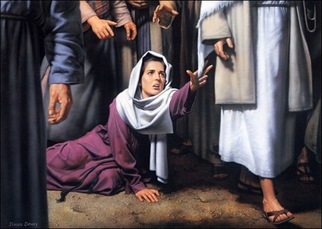 The story of the ceremonially unclean woman’s healing is “sandwiched” within the story of the raising of Jairus’ daughter. The first thing we might notice is the contrast between the woman and Jairus. Not only is the woman “unclean,” and therefore untouchable to any law abiding Jew; Jairus, as a leader of the synagogue, would have been one to enforce such laws. The unclean woman’s presence is an intrusion as Jesus is on his way to Jairus’ home, which most certainly would have been appalling to most of those looking on, and maybe most especially to Jairus. But it is an intrusion welcomed by Jesus, who recognizes and rewards her faith.
The woman’s belief that she would be “made well” could also be read “saved” (Gr. Sozo, and is the same word used by Jairus when he asks Jesus to heal his daughter). This theme of touching Jesus’ clothes and being “healed” or “saved” is repeated in 6:36; and Jesus’ statement, “your faith has made you well [i.e., saved you]” is repeated verbatim in 10:56. We have precedent in Mark of physical healing being associated with spiritual healing (i.e., salvation, or the forgiveness of sins) in 2:5-12; and also of the healing that Jesus performs being a response to faith. Whereas the woman only wants to touch Jesus’ clothes, and hopes to remain unnoticed; Jairus boldly asks Jesus to come into his home and “lay His hands” on his daughter. It is interesting that when Jesus addresses the woman, he tenderly calls her “Daughter,” which enunciates the wholeness of her healing—she is no longer an outcast, but a cherished family member of Israel’s household. (This may remind us of Isaiah’s image of the restoration of Israel's "daughters" which is prophetic of the New Jerusalem, cf. Isaiah 60:4). In both cases—the healing of the woman, and the raising of Jairus’ daughter—Jesus states that faith is required in order for healing and resurrection to take place. Whether you are an outcast of society, or a member of the religious and social elite, it is your faith that will “make you well,” a “wellness” that has significance beyond the present moment. As Morna Hooker states, "the child’s resurrection would be understood as a symbol of [Israel’s] own future resurrection. The story of the woman would have been of special interest to the Gentiles, since they too, had once been ‘outsiders’, excluded from the community of God’s people. Both stories would have brought reassurance of the new life and salvation which came to believers through the power of Jesus.” [1] [1] Morna D. Hooker, Gospel According to Saint Mark, The (Black's New Testament Commentary), Reprint ed. (Hendrickson: Baker Academic, 2009), 148. (This post is part of a series of short studies in Mark's Gospel) Mark 4: 11 And he said to them, "To you has been given the secret of the kingdom of God, but for those outside, everything comes in parables; 12 in order that "they may indeed look, but not perceive, and may indeed listen, but not understand; so that they may not turn again and be forgiven.' " What is the "mystery" or "secret" of the kingdom of God that Jesus speaks of, and how does this passage inform our understanding of the kingdom today? A major key to identifying the “mystery” or “secret” of the kingdom referred to in verse 11 is found in verse 12 (a quotation from Isaiah 6:9-10): those who would not understand this mystery would not be forgiven. Those who have been given understanding of the mystery of the kingdom respond with repentance that leads to forgiveness; whereas those who have not been given understanding do not repent, and remain “outside” and unforgiven. Mark introduces this association of the “mystery of the kingdom” with the forgiveness of sins from the very beginning of his gospel, when he equates the “good news,” or the Gospel, with the coming of the “kingdom.” This naturally leads us to consider the way that Paul uses the same word for mystery (Gr. Musterion) to refer to the mystery of the Gospel (cf. Ephesians 3:8-11; 6:19) and the mystery of Christ and His church (cf. Ephesians 5:32). I suggest that the “mystery of the Kingdom” is indeed the “mystery of the Gospel,” or “the mystery of Christ,” which “in former generations was not made known to humankind, as it has now been revealed to his holy apostles and prophets by the Spirit: that is, the Gentiles have become fellow heirs, members of the same body, and sharers in the promise [Israel’s hope] in Christ Jesus through the gospel” (cf. Ephesians 3:5-6).[1] The terms “kingdom of God” and “kingdom of heaven” are synonymous in Scripture. Therefore when we consider what it means to “enter” the “kingdom of God,” we should consider also what it means to enter “heaven,” or the presence of God, through faith in Christ. It is also helpful to consider the Scriptures upon which Jesus and the New Testament apostles were basing their understanding of the “kingdom.” For example, Psalm 145 associates God’s mercy (which he performed by the cross) with the power and glory of his kingdom. And Isaiah 52 connects the reign of God in “Zion” (which the writer of Hebrews equates with the church, cf. Hebrews 12:22-24) with Israel’s salvation and the proclamation of the Gospel. If one enters this “kingdom” (which is “heaven”) through belief in the Gospel, then it is understandable that those who expected a kingdom inaugurated through political deliverance from Roman oppression in the first century were those who were blind to the mystery—to the kingdom’s true nature--and that this blindness prevented them from “turning again and being forgiven.” And it is no different today, as there are those who are looking for a physical fulfillment of the kingdom of God, or “Heaven on earth,” and are blind to its true nature, and missing the joy of its present reality. [1] It is indeed appropriate, when reading and reflecting on the Scriptures theologically, to associate one writer’s teaching on the kingdom and the Gospel with another’s. Paul proclaims the Gospel that was the fulfillment of Israel’s hope, anticipated by her prophets. Mark states from the beginning that his Gospel (which he associates directly with the coming of God’s kingdom) is the fulfillment of those very same prophecies. Both Mark and Paul associate the “mystery” (of the kingdom, or the Gospel, respectively) with the forgiveness of sins. Mark and Paul both read the same Scriptures, and both saw Christ as fulfilling them. |

About Me:
I have been married to my loving husband Keith for 26 years. We have three beautiful and brilliant children, ages 24, 22 and 20. Nothing cheers my heart more than having them all at home, yet nothing is more satisfying to my mind than watching them grow from afar. My personal passion is theology: the knowledge and experience of the Truth and Mercy found only in the person and work of Jesus Christ, and displayed in the lives and communion of His people. My husband and I love to travel, and because our children are often out and about in the world, we get lots of opportunities to see it! And we also love to fill our home with friends who love us, and love our wine collection. Archives
November 2012
Categories
All
|

 RSS Feed